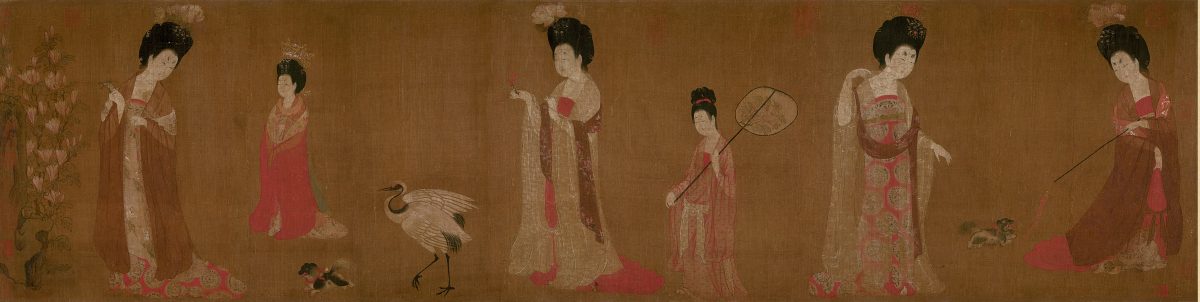
This year, I finally bit the bullet and offered to teach an in-person class, Tang Dynasty Courtesans 101, for the Courtesans College at Pennsic.
The funny thing about researching something is that you’ll come across something that requires you to research something else to understand it, and then that something requires you to research yet another thing, and so on. You try to look up the cost of a courtesan and end up digging through tax records and fabric weaves.
One of the questions I wanted to be able to answer in my class was just how much a top-tier courtesan’s time cost. We often refer to “high-rank courtesans” or “common brothels” or whatnot, but what does that MEAN? I started digging to be able to explain to the modern American mind just how expensive these ladies were.
The very first thing that one needs to know to even start this search is terminology: I don’t speak Chinese, alas, so I’ve needed to research the correct words to describe what I’m looking for, how many different ways is it spelled in the romanized alphabet (e.g., jia ji or cha ji), and the Chinese characters for those words (e.g., ji 妓 and chang 娼, both of which I have seen variously defined as “courtesans”, “prostitutes”, “singers/musicians”, or “entertainers”; however, chang has a ruder connotation–think “whore” instead of “prostitute”). Different characters may technically mean the same thing, but have different connotations. Learning the particulars of language around your subject will help make sure that you’re getting context and true meaning as correct as possible.
So back to the rabbit hole. The first topical branching off that I discovered was figuring out the value of various measurements of money in wen: bronze or silver coins (bronze were usually 1 wen, though the value of both depended on the purity of the material), “cash” (or strings of cash, which were literally bunches of coins on a string–the usual measurement being 1 string having 1000 wen coins), and ingots of gold or silver (“taels”) . A tael, or liang, is equal to a Chinese ounce–traditionally ~40 g/1.3 oz, though in the modern day, it is ~50 g/1.764 oz. In 840, 1 tael of silver = 1,000 wen and 1 tael of gold = 16 taels of silver.
All this gets more complicated when you find out that actual coinage often wasn’t always the accepted form of payment. At one point, during a copper shortage (and thus a coin shortage) in 734, an edict was put out specifying that “all transactions on residential property, slaves, and horses are to be paid in silk, hemp, ling silk twills, luo silk gauzes, silk thread, or floss (mian). Any other market prices that are in excess of 1,000 coins should be paid for in a mixture of coins and goods.” In 738, it was declared that officials and private individuals were required by law to use only plain or colored silk “in their exchanges at the market”. It gets even more brain-breaking when you try to factor in price inflation/deflation depending on the state of the empire (goods are harder to come by when there’s a major rebellion happening, for example). Occasionally, use of coins wasn’t permitted at all. In 809, there was an imperial edict forbidding even calculating the value of silk or hemp in coins.
Okay, so cloth was one of the primary forms of currency, especially for major purchases. So how to calculate its value? (Enter Rabbit Hole #2) The price varied widely by what type of cloth (not only silk vs hemp, but also the type of weave, how it was weaved (long or short loom), where it was made, the quality (high/medium/low)…. It goes on and on. Luckily, Tang Legal Code (written in 634 and widely established in 652) does stipulate a lot of prices using broad bolts of degummed silk, valued around 10 silver coins or 320 bronze coins in 650s-680s, which helps us at least set a baseline. The Code lists more than 350 commodities, including 33 different textiles sold variously by the bolt, piece, section, or foot. I’ll go into more details of what I’ve found there in a later post, since that’s a dozen or so different rabbit holes of its own, especially because it also requires getting into measurements of each fabric–what was considered a “standard” bolt, section, sheet, or foot for each cloth type–and that gets all kinds of complex.
The first solid information I found on value/cost was an early Tang tax code (I forgot to write down the year–I’ll find it again) that rated one man’s day of labor service as earning 3 feet of plain silk or 3 feet, 7 ½ inches of hemp. One bolt (pi) of plain silk cloth was 40 chi long, one bolt of hemp was 50 chi long, and 1 chi = 1 foot, 1 inch. Since several sources specified that “plain silk” = “degummed silk”, one can therefore calculate that around 650 CE, 1 man doing manual labor would earn 1 bolt of plain silk, valued at 10 silver coins or 320 bronze coins (~320 wen), in approximately 2 weeks with no days off. That’s around 640 wen per month–not even a single tael of silver.
Now that we have the approximate value of earnings for a commoner (I also have a bunch of tax documents describing the pay/compensation for various officials, but I still need to look up who each person was and what their actual job was to get a better grasp on rank, value, etc.), we can look at just how much a courtesan cost. According to historian Sung Te-hsi, a hosting a banquet in the Pingkang Ward of the capital city could cost between 9,600 to 38,400 wen (another source claims the price for an established patron as between 20-40 taels of silver). He doesn’t specify the time period or the reasons for the wide gap in price range, though he does mention that this was at a time that one peck of rice cost 40 wen and a “roll of silk” (why could he not be more specific?!) cost 200 wen. Depending on a specific courtesan’s ranking, buying out her contract could cost thousands of taels of silver. (We’ll get to rankings and contracts in another post.)
I’m going to cut off here for now, but you can see how looking for one simple bit of information can result in weeks of research on half a dozen or more completely separate topics. Wheeeee, rabbit holes!
Sources that I remembered to write down (I was in a rush to get things together for the class, so I slapped a bunch of it into a Word doc for personal use and forgot to write down a lot of the sources. I’ll dig back through and cite properly another time):
– “Supplement to the Relations between Coins and Silk from Gaochang Kingdom to Xizhou Prefecture”, in Zhu Lei (ed.), Tangdai de lishi yu shehui. Zhongguo Tangshi xuehui diliujie nianhui ji guoji Tangshi xuehui yantaohui lunwen xuanji
-Wuhan, 1997, pp. 320–325. Huang Lou , “Studies in the Documents Concerning yueliao, chengliao, and keshi tingliao”
-Dunhuang Tulufan yanjiu 11, (Shanghai, 2008 [published 2009]), pp. 249–267
-Lin Xiaojie , “Time and Space in the Daily Life of Officials in Xizhou Prefecture under Tang”
-Wu, JunRu (2021-12-31). “The Curious Case of Chinese Courtesan Culture”. The Mirror – Undergraduate History Journal. 41 (1): 29–30. ISSN 2562-9158.
-Document No. 4: Records of Receipt of Expenses in Beiting under Tang
-Jing Wang, 2009, “Courtesan Culture in the Beili Zhi (Records of the Northern Quarter) in the Context of Tang Tales and Poems”, PhD Dissertation, University of Wisconsin-Madison.


 Sartorial Dominance Displays