Research Rabbit Holes, part 1

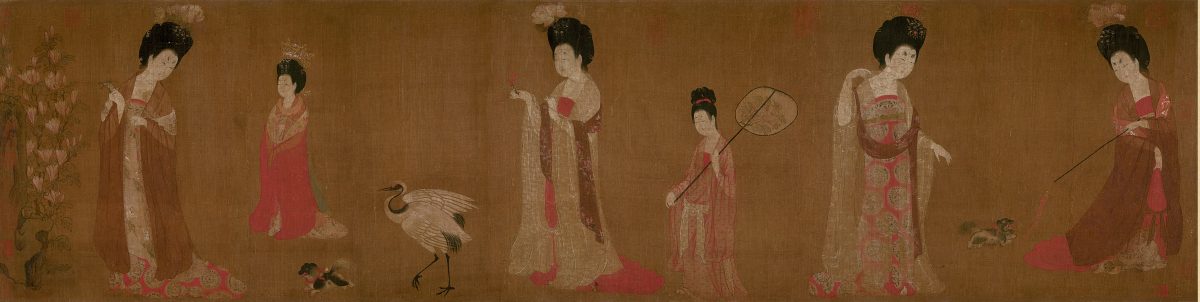
This year, I finally bit the bullet and offered to teach an in-person class, Tang Dynasty Courtesans 101, for the Courtesans College at Pennsic.

The funny thing about researching something is that you’ll come across something that requires you to research something else to understand it, and then that something requires you to research yet another thing, and so on. You try to look up the cost of a courtesan and end up digging through tax records and fabric weaves.

One of the questions I wanted to be able to answer in my class was just how much a top-tier courtesan’s time cost. We often refer to “high-rank courtesans” or “common brothels” or whatnot, but what does that MEAN? I started digging to be able to explain to the modern American mind just how expensive these ladies were.

The very first thing that one needs to know to even start this search is terminology: I don’t speak Chinese, alas, so I’ve needed to research the correct words to describe what I’m looking for, how many different ways is it spelled in the romanized alphabet (e.g., jia ji or cha ji), and the Chinese characters for those words (e.g., ji 妓 and chang 娼, both of which I have seen variously defined as “courtesans”, “prostitutes”, “singers/musicians”, or “entertainers”; however, chang has a ruder connotation–think “whore” instead of “prostitute”). Different characters may technically mean the same thing, but have different connotations. Learning the particulars of language around your subject will help make sure that you’re getting context and true meaning as correct as possible.

So back to the rabbit hole. The first topical branching off that I discovered was figuring out the value of various measurements of money in wen: bronze or silver coins (bronze were usually 1 wen, though the value of both depended on the purity of the material), “cash” (or strings of cash, which were literally bunches of coins on a string–the usual measurement being 1 string having 1000 wen coins), and ingots of gold or silver (“taels”) . A tael, or liang, is equal to a Chinese ounce–traditionally ~40 g/1.3 oz, though in the modern day, it is ~50 g/1.764 oz. In 840, 1 tael of silver = 1,000 wen and 1 tael of gold = 16 taels of silver.

All this gets more complicated when you find out that actual coinage often wasn’t always the accepted form of payment. At one point, during a copper shortage (and thus a coin shortage) in 734, an edict was put out specifying that “all transactions on residential property, slaves, and horses are to be paid in silk, hemp, ling silk twills, luo silk gauzes, silk thread, or floss (mian). Any other market prices that are in excess of 1,000 coins should be paid for in a mixture of coins and goods.” In 738, it was declared that officials and private individuals were required by law to use only plain or colored silk “in their exchanges at the market”. It gets even more brain-breaking when you try to factor in price inflation/deflation depending on the state of the empire (goods are harder to come by when there’s a major rebellion happening, for example). Occasionally, use of coins wasn’t permitted at all. In 809, there was an imperial edict forbidding even calculating the value of silk or hemp in coins.

Okay, so cloth was one of the primary forms of currency, especially for major purchases. So how to calculate its value? (Enter Rabbit Hole #2) The price varied widely by what type of cloth (not only silk vs hemp, but also the type of weave, how it was weaved (long or short loom), where it was made, the quality (high/medium/low)…. It goes on and on. Luckily, Tang Legal Code (written in 634 and widely established in 652) does stipulate a lot of prices using broad bolts of degummed silk, valued around 10 silver coins or 320 bronze coins in 650s-680s, which helps us at least set a baseline. The Code lists more than 350 commodities, including 33 different textiles sold variously by the bolt, piece, section, or foot. I’ll go into more details of what I’ve found there in a later post, since that’s a dozen or so different rabbit holes of its own, especially because it also requires getting into measurements of each fabric–what was considered a “standard” bolt, section, sheet, or foot for each cloth type–and that gets all kinds of complex.

The first solid information I found on value/cost was an early Tang tax code (I forgot to write down the year–I’ll find it again) that rated one man’s day of labor service as earning 3 feet of plain silk or 3 feet, 7 ½ inches of hemp. One bolt (pi) of plain silk cloth was 40 chi long, one bolt of hemp was 50 chi long, and 1 chi = 1 foot, 1 inch. Since several sources specified that “plain silk” = “degummed silk”, one can therefore calculate that around 650 CE, 1 man doing manual labor would earn 1 bolt of plain silk, valued at 10 silver coins or 320 bronze coins (~320 wen), in approximately 2 weeks with no days off. That’s around 640 wen per month–not even a single tael of silver.

Now that we have the approximate value of earnings for a commoner (I also have a bunch of tax documents describing the pay/compensation for various officials, but I still need to look up who each person was and what their actual job was to get a better grasp on rank, value, etc.), we can look at just how much a courtesan cost. According to historian Sung Te-hsi, a hosting a banquet in the Pingkang Ward of the capital city could cost between 9,600 to 38,400 wen (another source claims the price for an established patron as between 20-40 taels of silver). He doesn’t specify the time period or the reasons for the wide gap in price range, though he does mention that this was at a time that one peck of rice cost 40 wen and a “roll of silk” (why could he not be more specific?!) cost 200 wen. Depending on a specific courtesan’s ranking, buying out her contract could cost thousands of taels of silver. (We’ll get to rankings and contracts in another post.)

I’m going to cut off here for now, but you can see how looking for one simple bit of information can result in weeks of research on half a dozen or more completely separate topics. Wheeeee, rabbit holes!

Sources that I remembered to write down (I was in a rush to get things together for the class, so I slapped a bunch of it into a Word doc for personal use and forgot to write down a lot of the sources. I’ll dig back through and cite properly another time):

– “Supplement to the Relations between Coins and Silk from Gaochang Kingdom to Xizhou Prefecture”, in Zhu Lei (ed.), Tangdai de lishi yu shehui. Zhongguo Tangshi xuehui diliujie nianhui ji guoji Tangshi xuehui yantaohui lunwen xuanji
-Wuhan, 1997, pp. 320–325. Huang Lou , “Studies in the Documents Concerning yueliao, chengliao, and keshi tingliao”
-Dunhuang Tulufan yanjiu 11, (Shanghai, 2008 [published 2009]), pp. 249–267
-Lin Xiaojie , “Time and Space in the Daily Life of Officials in Xizhou Prefecture under Tang”
-Wu, JunRu (2021-12-31). “The Curious Case of Chinese Courtesan Culture”The Mirror – Undergraduate History Journal. 41 (1): 29–30. ISSN 2562-9158.
-Document No. 4: Records of Receipt of Expenses in Beiting under Tang
-Jing Wang, 2009, “Courtesan Culture in the Beili Zhi (Records of the Northern Quarter) in the Context of Tang Tales and Poems”, PhD Dissertation, University of Wisconsin-Madison.

Translating the Bei Li Zhi (北里志)

I have a new project that I’ve VERY excited about! I’ve been talking to a translator who specializes in Classical Chinese texts and we’ve agreed on a contract for a translation of the Bei Li Zhi (Anecdotes of the Northern Ward) with commentary! The commentary is going to focus on defining euphemisms, which will be a huge help when reading other resources. So far as I can find, it will be the first translation of the Bei Li Zhi into English–there is one translation into French, published in 1968, by Robert Des Rotours. You can find it in a library through WorldCat.org. (https://search.worldcat.org/title/1049424265?fbclid=IwY2xjawK9DwNleHRuA2FlbQIxMABicmlkETFBRndSVjU1ZmNFcDAwME1qAR4BMH_j9gNxqFunpEsNYdps77WUhsCRxYp8DwUGermteWzzYhWGUIAGclh-_Q_aem_UNU4bysD4r68oQHVzzqR0Q)

Even better, his terms of use are just that he receives credit as the translator. He’s even encouraged me to clean it up and publish sometime after we’re done, which could help fund future translation work!

The Bei Li Zhi is a major primary source of anecdotes about courtesans in the Tang capital of Chang’an, originally written by Sun Qi in 884. There are more than 10 chapters describing the Pingkang Ward (the pleasure district where the courtesans lived), the courtesans themselves, and the scholars/literati who were their clients.

From some of the (awful!!!) Google translations I’ve run the document through, the level of detail about the women’s lives and what each was known for is so much more than I’ve found anywhere else so far. I am very much looking forward to digging in and learning more from this!

Also, since translation services, especially rare ones like Classical Chinese, are EXPENSIVE (this one is costing $2500), I’m running a gofundme to help me pay for this project. If you’re interested in contributing, the fundraising site is https://gofund.me/e22f5abf. Everyone who contributes will receive a copy, of course!

Touhu!

At War of the Roses this past weekend, I finally got the touhu (pitch pot) set out and got people to play a few rounds.

I did alter the traditional rules some to make it more accessible/appealing to SCA players (I, for one, am TERRIBLE at poetry and coming up with words off the cuff). I also added that the winner of each round could request a small boon of the defeated–a story, a dance, a song…. whatever, so long as the defeated consented to the request. So we did use the traditional 2.5 arrow length distance, but the rest of the rules were somewhat ad hoc.

Results: HILARIOUS. Several of my players declined the alcohol portion of the game, but decided instead to stick with the on-the-spot poetry composition! None of it was even remotely Chinese-style poetry (most were limericks), but a both players and bystanders were shouting with laughter and a great deal of fun was had. I’ll put up some of the videos as soon as I get them off my phone.

I did NOT shout “A&S!!!” beforehand, but I really should have. lol

Helpful Terminology for Tang Dynasty Clothing

Primarily from BuYun Chen’s “Dressing for the Times: Fashion in Tang Dynasty China (618-907)” 2013 Columbia University PhD dissertation and some from Wikipedia (confirmed in other sources–I just wanted to get the characters for each item and Wikipedia had those where I could copy/paste them)

shan 衫 – unlined short robe or top

ru 襦 – short jacket

qun 裙 – skirt

ruqun 襦裙 – jacket and skirt ensemble

pibo 披帛 – long shawl

ao 袄 – coat

pao 袍- cloak

banbi 半臂 – cropped short-sleeved jacket

jianse qun 間色裙 – striped skirt

po 破 – sections of a skirt (early Tang (618-712) restricted skirts to 12 po, later they were restricted to 7 during the reign of Emperor Gaozong, then 5 in 826 by Emperor Wenzong)

shiliu qun 石榴裙 – pomegranate red skirt

bainiao qun 百鳥裙 – hundred bird feather skirt

tanling ruqun 坦领襦裙 – u-shaped neckline ruqun

qixiong ruqun 齊胸襦裙 – high-waisted/chest-high ruqun

daxiushan 大袖衫 – large-sleeve gown

hufu 胡服 – foreign/”barbarian” clothing

yuanlingpao/yuanlingshan 圓領袍/圓領衫 – round-collar jacket/robe

bixi 蔽膝 – a cloth attached from the waist, covering front of legs, for more formal occasions

Hats

weimao 帷帽 – wide-brimmed hat with a shoulder-length gauze veil, more popular in Tang than the more conservative mili

mili 羃䍦 – wide-brimmed hat with a long (full body) veil

futou 襆頭/幞頭 – lit. “head scarf”, black kerchief with ribbons dangling worn by men; later, hard ribbons were added that stuck out at the sides

Courtesan-/Sex-Related Terminology and Euphemisms

A lot of source material about courtesans in the Tang Dynasty is found in poetry of the time, and poetry is full of symbolism and euphemisms. Here are some euphemisms I’ve found while reading that can help you puzzle out what the flowery language is ACTUALLY talking about! I’ll include the associated characters whenever possible, and this list will update from time to time as I find more useful info.

My Chinese is terrible and all of these were taken from other sources/translations, so if I’ve gotten something wrong or if you know more terms or euphemisms, let me know in the comments!

Terminology

ji 妓, chang 娼, chi – “For the purposes of this article, I will generally use the terms “entertainer” or “courtesan,” but these English terms are at best crude approximations; I shall argue that they do not capture important distinctions implied by the words ji and chang up to and through most of the Tang.” (Taken verbatim from Bossler, B., “Vocabularies of Pleasure”), sometimes also translated as “prostitute” or “whore”. Edward Schafer suggested that the term ji implied greater gentility than chang, but he did not explore the origins of the distinction; see his “Notes on T’ang Geisha,” Schafer Sinological Papers (1984), nos. 2, 4, 6, 7 (Library of University of California, Berkeley), no. 2, p. 4.

chia-ji/jia-ji – “household” courtesans/entertainers, privately owned, acquired either by being purchased or gifted

ming-ji 名妓- brothel courtesans/entertainers, usually owned by courtesans-turned madams

guan-ji 官妓- official courtesans/entertainers, owned by the government and assigned to civil officials

ying-ji 營妓- military courtesans/entertainers, owned by the government; note that these were not of lower class than the other types of courtesans–they served the military officials rather than being “camp follower”-type prostitutes

kung-ji – palace courtesans/entertainers, owned by the government

Note: Wang Shu-hu notes 23 different terms that refer to courtesans and prostitutes, so there are many more that I don’t have listed, see Wang, Chung-ku ch’ang-chi shih. (I have not actually read this article yet, as I don’t read Chinese, but I’m hunting down a copy and will see if I can get it translated.)

jiaofang – Entertainment Bureau, where entertainers/courtesans registered with the government

demimonde – a common romanticized term for female entertainers

changlou 倡 or 娼樓 – “entertainment pavilions” (brothels)

ji lou 妓樓 – courtesan/entertainment pavilion, see changlou

liyuan dizi 梨園弟子 – “Pear Garden disciples”, later a euphemism for courtesans and eventually a rude slur; the Pear Garden was the palace school for entertainers/courtesans

guanji 觀妓 – watching courtesans

tingji – listening to courtesans

tanxue – conversation and jokes

geling – singing lyrics and drinking games

changjia – a dashing and wealthy young man who frequented the houses of courtesans

yunji – a reserved and cultivated person

qie 妾 – concubine; these women were neither wives nor courtesans, but functioned like wives with fewer rights in a household, meant to bear the “husband” children and exclusively for him (as opposed to a house courtesan, who could be loaned out or gifted to others)

Euphemisms

Long-legged horses – young girls, often used in context of them being sold as slaves

Silk socks (lo-wa) – a dancer’s feet

Se, meaning “color” or “beauty” – often insinuates sexuality

“Kingfisher pins” or “carmine sleeves” – imply beauties/beautiful women

Zhuanglou – either a woman’s boudoir or to a qinglou, a bordello/brothel

Genyi – euphemism for privy, also a person who works in the imperial wardrobe

Eastern mountain wanderings – poetic trope for dallying with courtesans

Spring boats, painted boats, flower boats – courtesan or prostitution boats, especially “notorious” in Yangchou

“State toppler” – a particularly beautiful woman, implies the dangers of beautiful women

“Fallen flower” – courtesan/prostitute

“Clouds and rain” – sex

Waiting for a flower to bloom – waiting for a girl to have her first menstruation and therefore be available for sex

Sources

Bossler, B. 2012. “Vocabularies of pleasure: Categorizing female entertainers in the late Tang Dynasty.” Harvard Journal of Asiatic Studies 72.1 (2012): 71-99.

Yao, P. 2002. “The Status of Pleasure: Courtesan and Literati Connections in T’ang China”. Journal of Women’s History. v. 14, No. 2, pp. 26-53. https://muse.jhu.edu/article/17470/summary

Wang Shu-nu. 1933; reprint, 1988. Chung-kuo ch’ang-chi shih. (A history of prostitution in China). Shanghai: Shang-hai san-lien shu-tien.

Wangling Jinghua. 2009. “Singing Lips in Observation: Ninth-Century Chinese Poetry on Female Entertainers”. Ph.D. diss., Harvard University.

Schafer, E. 1984. “Notes on T’ang Geisha,” Schafer Sinological Papers. nos. 2, 4, 6, 7 (Library of University of California, Berkeley), no. 2, p. 4.

Current Project: a Mongolian Boqta

I have a brand, and that brand is apparently Fancy Headgear.

I was honored to be asked if I’d be willing to make a boqta for a baroness/vicerine who I like a lot but haven’t gotten to spend much time with’s deinvestiture. It being me, I’m going for the Boqta to End All Boqtas.

I do enjoy Extra. 🙂

In progress photos and finished shots won’t be posted until after the event (I’d like her to see it first), but here’s some research photos! I will also add links to resources I used after it’s done and my brain remembers to document things.

Pennsic Doings (aka my continuing fight with gravity)

I made very little for myself for Pennsic 2022, which is for the best. This meant that I was available when Remy desperately needed new clothes–he out-swoled nearly all of his–and I am sufficiently extra (and versed in Cavalier-era garb) to make some for him so he didn’t have to stress about it.

The goal was 3 new doublets and 3 new breeches, but I only managed 2 of each, partly due to a Gravitational Anomaly the day before I was due to leave for Pennsic. Aka I’m super clumsy and fell down the front stairs while hauling bins out to the car and broke my left elbow, bruised some ribs, and bashed my forehead into the street. No really. I headbutted the street. Asphalt and I are not friends. Fortunately, I did not have a concussion, just a really gnarly egg that was super vein-y and creepy looking. The broken arm and SUPER unhappy ribs were a much bigger problem. Still, I am a stubborn creature and continued the hand-sewing portions of working on Remy’s garb anyway because we can’t have Remy running around Pennsic naked. Even if many jokes were made that I’d get a service award if he did. 🙂 I promise that I stopped when it hurt more than hand sewing normally does.

In the ER waiting to be seen the night I went ass over teakettle.

I did use his pre-existing pattern with a little bit extra put in the seams to accommodate the extra swole. The results went a bit weird (there ended up being WAY too much fabric in the front seam and we’re not sure how that happened), but it was possible to work with it and get things looking mostly decent. I’ll post pics when I take some of the one yet-unfinished outfit.

On the plus side, I did have his fancy royal blue velveteen with silver woven trim ready for his Champ’s fight, and it looked LOVELY in the sunlight. I have plans to add some more trim to it (I was short on time) and I only have a couple of photos of it in action, so I need to dress him up and make him pose for me to show it off properly.

Remy in fancy doublet and pants, killing Max during the first ever spear fight done for Pennsic Rapier Champs. Good job, Remy!

Resources Master List

As I go through trying to organize my thoughts, I am constantly forgetting exactly where I found xyz information, so maybe this will be a way to help people see where I’m getting my info. 🙂

DEFINITELY not a complete list! This is just for starters. Welcome to my library!

This is also not currently organized into topic sections—I hope to get to that eventually, but it’s gonna take a while. I have a LOT of sources! I am constantly digging through JSTOR and journal article repositories for new info.

Books:

I also have several books in Chinese that I need to have translated. I’m also desperately seeking an English translation of the Beili Zhi, “The Records/Analects of the Northern Ward”.

Websites:

First, a note. A lot of websites don’t cite sources, but they can be very helpful for finding terminology to search for and especially for finding Chinese names/characters for things. They can also be excellent jumping-off points if they do cite sources. Just going through Wikipedia can net you all kinds of terminology to go digging for. Verify everything with multiple sources!

Journal Articles:

Other A&S Blogs:

Current Hairpiece Project

A Double Ban Fan Ji (半翻髻)

Looking through a lot of extant tomb murals and pottery figurines from the Tang Dynasty, one of the hairstyles that I see a LOT is what looks like two tall wings sweeping back from the top of the head (see photos below). A lot of digging found that this style was called “Ban Fan Ji” or upswept bun. The specific two-wing version I’m looking at is a double ban fan ji.

The single ban fan ji appears to have been more popular, but as both are still common (and I already have a very long, thin face rather than the preferred round face), I decided that the double ban fan ji hairpiece would add a bit more width and be more flattering on me.

There is also significant evidence of false hairpieces and wigs being used in the Tang Dynasty (and earlier). There are a few pieces still extant, though I haven’t been able to find out exactly how they were attached to one’s head yet. I still don’t read Chinese, alas, so there’s a lot of waiting for translations involved. One of the extant pieces is painted wood, one is horse hair on some kind of shaped base, and I’ve also found a less-specifically shaped base made of cloth and wire–I need to dig the image for that up and I’ll add it when I find it again.

Some of my materials for making hairpieces are NOT period. Extant hairpieces were made of wood, cloth, and/or wire, but I use wire and foam sheets to be able to keep the final piece as light as possible. These things get heavy FAST and I much prefer not to have a massive headache and neck ache all day from trying hold my hairpiece up. I also use enormous amounts of glue, which may be period (looks like it, from what I can see on that horse hair piece). There’s a good chance that there was a lot of wax involved in styling hair and hairpieces, but I’ve tried that once and unless I want to have that style in for at least a week, it isn’t worth the effort required for SCA purposes. It’s also really hard on your real hair and scalp.

I’m hoping that weather will cooperate for GNEW in two weeks–if so, I’ll bring a bunch of material and work on a piece out where people can watch what I’m doing. 🙂

Fighting Writer’s Block (and how the [bad language] does WordPress work?!?!)

I’m trying, yet again, to get this blog off the ground, but I have been fighting a lot of writer’s block, a lot of lack of energy, and even more trying to figure out how to get WordPress to do pretty much anything. This is definitely not an intuitive platform!

I am absolutely an editor and not a writer (or a graphic designer), so apologies that a lot of my information is going to at least start off being very stream-of-consciousness and likely a giant mess to look at. Hopefully it makes some semblance of sense.